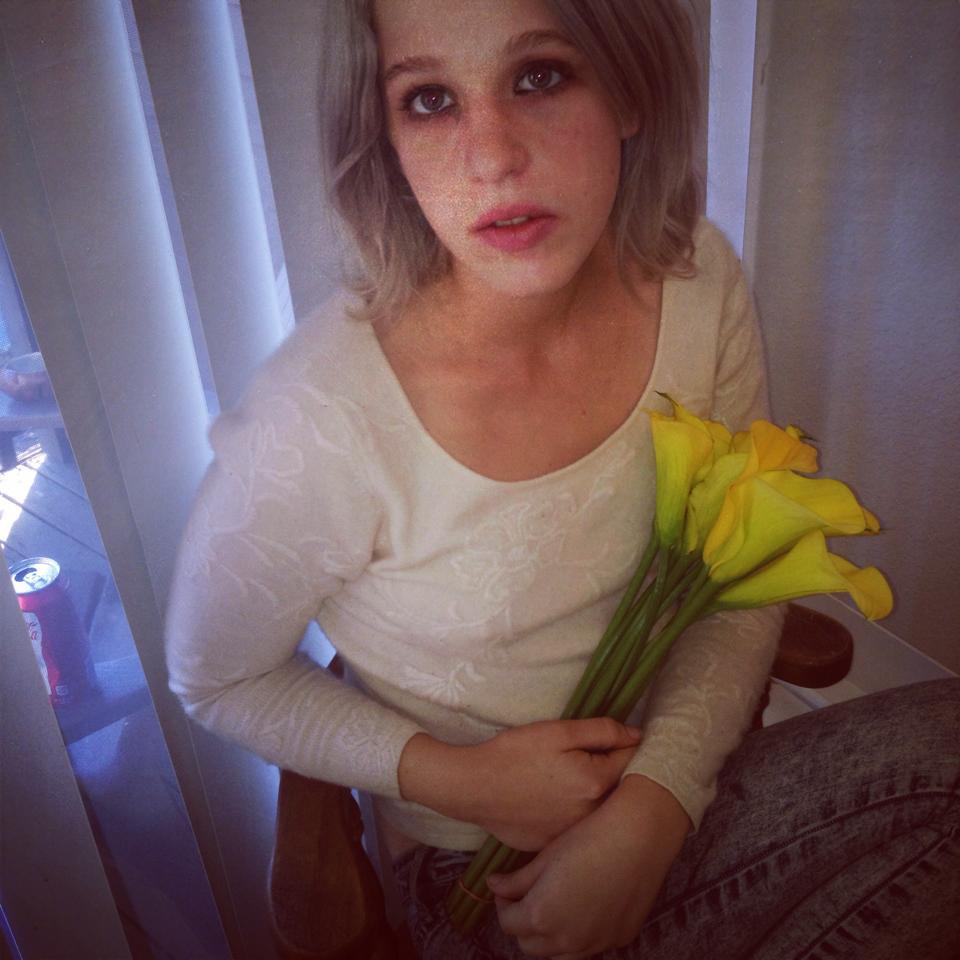

Tag: light

from The Apple Trees at Olema By Robert Hass
Félix González-Torres, “Untitled (Placebo — Landscape — for Roni),” 1993. Candies, individually wrapped in gold cellophane, endless supply, Ideal weight: 1,200 lbs., overall dimensions vary with installation.
Roni Horn, “Paired Gold Mats, for Ross and Felix,” 1994-5. Gold, 49 x 60 x .0008 in.
“As the following text by Felix Gonzalez-Torres illuminates, Felix was moved and influenced by Roni Horn’s work well before he knew her. Subsequently, they became friends, sharing a dialogue of rare intensity. Felix was very good at maximizing the strongest aspect of each of his relationships, and he touched and was touched by many. However, there were very few people who Felix felt akin to in as many fields as he did with Roni-artistic, political, and personal.
The format of Felix’s memorial was primarily the reading of letters exchanged between Felix and others. Roni was one of few people asked to speak-at Felix’s request. The second text below is a portion of that poetic text.
excerpt from “1990: L.A., "The Gold Field”, by Felix Gonzalez-Torres
from Earths Grow Thick, Wexner Center for the Arts Roni Horn exhibition catalogue, 1996
L.A. 1990. Ross and I spent every Saturday afternoon visiting galleries, museums, thrift shops, and going on long, very long drives all around L.A., enjoying the “magic hour” when the light makes everything gold and magical in that city. It was the best and worst of times. Ross was dying right in front of my eyes. Leaving me. It was the first time in my life when I knew for sure where the money for rent was coming from. It was a time of desperation, yet of growth too.
1990, L.A. The Gold Field. How can I deal with the Gold Field? I don’t quite know. But the Gold Field was there. Ross and I entered the Museum of Contemporary Art, and without knowing the work of Roni Horn we were blown away by the heroic, gentle and horizontal presence of this gift. There it was, in a white room, all by itself, it didn’t need company, it didn’t need anything. Sitting on the floor, ever so lightly. A new landscape, a possible horizon, a place of rest and absolute beauty. Waiting for the right viewer willing and needing to be moved to a place of the imagination. This piece is nothing more than a thin layer of gold. It is everything a good poem by Wallace Stevens is: precise, with no baggage, nothing extra. A poem that feels secure and dares to unravel itself, to become naked, to be enjoyed in a tactile manner, but beyond that, in an intellectual way too. Ross and I were lifted. That gesture was all we needed to rest, to think about the possibility of change. This showed the innate ability of an artist proposing to make this place a better place. How truly revolutionary.
This work was needed. This was an undiscovered ocean for us. It was impossible, yet it was real, we saw this landscape. Like no other landscape. We felt it. We traveled together to countless sunsets. But where did this object come from? Who produced this piece that risked itself by being so fragile, just laying on the floor, no base, no plexiglass box on top of it…. A place to dream, to regain energy, to dare. Ross and I always talked about this work, how much it affected us. After that any sunset became “The Gold Field.” Roni had named something that had always been there. Now we saw it through her eyes, her imagination.
excerpt from An Uncountable Infinity-For Felix Gonzalez-Torres-February 1996-by Roni Horn as read at Felix Gonzalez-Torres’ memorial
A field of waves, perhaps an ocean: up close two different tiles recur to form a puzzle in which the image of water coheres. Among these tiles a labyrinth forms as my gaze loops between them and the water.
I am attracted to the little edibles, brightly colored candies mostly, as I partake of the metaphor that would send you around the world. I am a bumble bee-who would pollinate the world with you.
Images of sky, birds, water, murdered people, and certain colors stacked in measures of some critical mass. Each image forms a slice of some lesser but more acute mass that as a letter going out into the world whole, is only completed when it finds the place it is destined for. Each slice signals its own fate.
I am cast into an abrasive and exquisite consciousness.
Everything of me, everything outside of me is tempered by it.
I am laid open.
My skin, my consciousness are turned to glass.
The only risk left now is that of openness.
Framed by sky, buildings, roadways, and signs, the photographs out there on the street-between food and home-bring enigma near. And these enigmas recur. They are riddles that implicate public and private, you and me, us. They open up an Egypt-like space, when Egypt was mostly desert and when Egypt was mostly desert without parking lots, even vacant ones.
You are more nature. Your life is a rare form of transparency through which I have observed the world becoming more present to itself and through which I have become more present to myself. And in all of this, I recognize you, Felix, as another weather.”
—Andrea Rosen Gallery
“Writing about González-Torres’ unmade bed billboard, Muñoz elaborates what he means by disidentity thusly: “There is in fact nothing to identify with — no figure, no text, no gesture, barely an object, only an absence. What is evoked is a ‘structure of feeling’ that cuts through certain Latino and queer communities but is in no way exclusive to any identitarian group. I am suggesting that the image connotes a disidentity, a version of self that is crafted through something other than rote representational practices, produced through an actual disidentification with such practices and the public/private binary.” The artist’s golden landscape portrait of Horn could be said to operate similarly. The work is not only on the ground, but it is all ground; there is no figure, text, or gesture. Certainly there are the objects of the individual pieces of candy, but even these constitute an absence as viewers are meant to consume them. The work does not depict Horn, but performs a feeling, it feels, it feels like her, a feeling that, to take into consideration the etymology of the work’s parenthetical descriptor placebo, is pleasing. Horn’s work is, by comparison, more restrained — it is smaller and consists of less pieces — and more precious — it is comprised of pure gold rather than cellophane-wrapped candies. It exists as a sort of compressed and refined version of González-Torres’ placebo landscape. Yet, it still functions in the same way, being less about any one-to-one correspondence between its materials and its referents and more about the commonality, the being-in-common, it evokes.In his essay on Horn’s prior work Gold Field that instigated the artists’ friendship, González-Torres carnally highlights his intuition of just this aspect of the work: “Recently Roni revisited the Gold Field. This time it is two sheets. Two, a number of companionship, of doubled pleasure, a pair, a couple, one on top of the other. Mirroring and emanating light. When Roni showed me this new work she said, ‘there is sweat in between.’ I knew that”
—From BETWEEN THE GROUND AND THE SKY | Daniel Sander


untitled (key west) by felix gonzalez-torres
Cy Twombly, Tree (I) (Capri), 1986.
Cy Twombly, Sculpture Detail, negative 1998; print about 2000. Color dry print. Image: 17.8 x 16.5 cm (7 x 6 ½ in.). Sheet: 27.9 x 21.6 cm (11 x 8 ½ in.)
Cy Twombly , Polaroids, Maroc, 2005
Cy Twombly, Lemons (Gaeta), 2005, color dry-print, 10 ¼ × 9 15/16 inches (26 × 25.2 cm)
Cy Twombly, Tulips, Rome 1985
Cy Twombly, Peonies, Bassano in Teverina, 1980
Cy Twombly, Pasargade, 1994 (Gaeta), Color dry-print, 11 x 8 ½ inches (27.9 x 21.6 cm)

Virginia Woolf, The Waves

Dan Flavin, Fluorescent Lights, 1968
Extension (1), 2007, mixed media, 500 x 500 x 400 cm h, Photo credits: Studio Hans Op de Beeck


Nan Goldin

 Little Bristling Soul