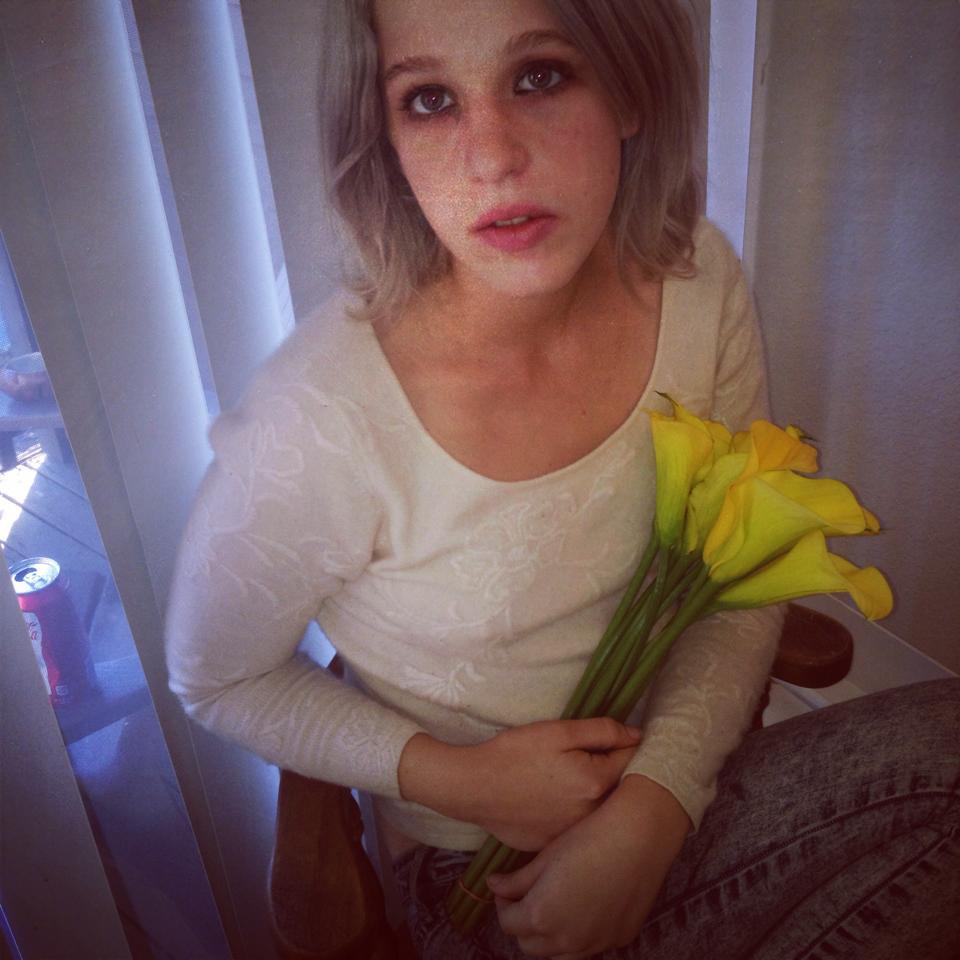
I thought we were playing a game
in a forest that day.
I ran as my mother chased me.

But she’d been stung by a bee.
Or bitten by a snake.
She shouted my name, which

even as a child I knew was not
“Stop. Please. I’m dying.”

I ran deeper
into the bright black trees
happily
as she chased me: How

lovely the little bits and pieces.
The fingernails, the teeth. Even
the bombed cathedrals
being built inside of me.

How sweet
the eye socket. The spine. The
curious, distant possibility that God
had given courage
to human beings
that we might
suffer a little longer.

And by the time

I was willing to admit that
all along
all along
I’d known it was no game

I was a grown woman, turning
back, too late.

“Game” by Laura Kasischke. From Poetry (October 2012)

POEM

My hayseed harlequin
what’s a bloomer to you

and a bobbin to him?
Two grams of Melatonin

won’t put the bitch to bed.
—She’s mazing in bloody pastures.

—She’s got a equinox in the head.
Five six seven eight nine

black angels—ten twelve
fourteen eighteen fare-thee-wells—

won’t scrub the slate to static—
won’t turn the tone to knell—

kneaded and seeded and gadgeted, well,
it’s a why-you-dunnit

and a heck and a hell
and a moon-stung stutter

and a hazy hotel
when a kiss is a vanish

and a flown is a fell.

–Karen Volkman

descriptions of dissociation

themostradicalthing:

theneurotypicals:

Depersonalisation

Common: ‘I felt strange / weird’, ‘I felt as if I was floating away’, ‘I felt disembodied / disconnected / detached / far away from myself’, ‘apart from everything’, ‘in a place of my own / alone’, ‘like I was there but not there’, ’I could see and hear everything but couldn’t respond’

Less Common: ‘puppet-like’, ‘robot-like’, ‘acting a part’, ‘I couldn’t feel any pain’ ‘like I was made of cardboard’,  ‘I felt like I was just a head stuck on a body’, ‘like a spectator looking at myself on TV’, ‘an out of body experience’, ‘my hands or feet felt smaller / bigger’. ‘when I touched things it didn’t feel like me touching them’

Derealisation

‘My surroundings seemed unreal / far away’, ‘I felt spaced out’, ‘It was like looking at the world through a veil or glass’, ‘I felt cut off or distant from the immediate surroundings’, ‘objects appeared diminished in size /  flat / dream-like / cartoon like / artificial / unsolid’

Other dissociative symptoms 

Memory: “I drove the car home/got dressed/had dinner but can’t remember
anything about it”, “I don’t know who I am or how I got here” (fugue state), “I
remember things but it doesn’t feel like it was me that was there”. 

Identity: “I feel like I’m two separate people/someone else”. 

Other: “I felt like time was passing incredibly slowly/quickly”, “I get so absorbed
in fantasy/a TV programme that it seems real”, “I felt an emptiness in my head
as if I was not having any thoughts at all”. 

Source: Jon Ston. Dissociation: What Is It and Why Is It Important? Practical Neurology, 2006; 6: 308-313.

This is seriously something all psychiatric students/professionals/diagnosticians need to read.

There are not enough dissociation-specific “layman’s” words and phrases to highlight what folks with dissociative disorders (or other conditions with marked dissociation) go through.

All we have are these vague sounding terms like the above. So often they’re ignored/belittled, when instead they should be taken seriously and taken as indications to investigate the possibility of dissociation further.

If I had this sort of vocabulary I wouldn’t have spent 8 mystified years referring to how I spent a huge chunk of my waking life as “that feeling that there isn’t a word for” or  “the water running out of the bathtub feeling”

Sexual difference is the site where a question concerning the relation of the biological to the cultural is posed and reposed, where it must and can be posed, but where it cannot, strictly speaking, be answered. Understood as a border concept, sexual difference has psychic, somatic, and social dimensions that are never quite collapsible into one another but are not for that reason ultimately distinct. Does sexual difference vacillate there, as a vacillating border, demanding a rearticulation of those terms without any sense of finality? Is it, therefore, not a thing, not a fact, not a presupposition but rather a demand for rearticulation that never quite vanishes – but also never quite appears?

Judith Butler, from Undoing Gender

cryptomnesia:

In the end what can I do with you—tenderness
tenderness for birds and for people for a stone
you should sleep in a palm in the eye’s depths
that’s your place may you be woken by no one

You spoil everything you get it back to front
you contract a tragedy into a pocket romance
you change the high-toned flight of a thought
into sobbing and exclamations into moaning

To describe is to murder because it’s your role
to sit in the darkness of a cold and empty hall
to sit solitary where reason blithely rattles on
with mist in a marble eye tears running down

Tenderness, Zbigniew Herbert.

translation Alissa Valles.

Even after we stopped seeing each other, I thought of her with great fondness. Memories of her encouraged me, soothed me, as I passed through the confusion and pain of adolescence. For a long time, she held a special place in my heart. I kept this special place just for her, like a “Reserved” sign on a quiet corner table in a restaurant. Despite the fact that I was sure I’d never see her again.

Haruki Murakami, South of the Border, West of the Sun (via ar-rad)

mortalpractice:

Everything Important

happens behind my back.
Water lilies open, then close.
Nations are born. Friends up and leave
their sturdy bodies. The stonechat takes flight.
A son learns to whistle. A daughter finds
the greatest common factor, then falls
in love. One morning the leaves
are off the elm and halfway down the block.
And in the spring, however faithfully I check
for the first bloom along the secret alley
of camellias, I will be looking away,
will see them only once they’re a jostling palaver
of pink and white, so impossible a brightness
I will forget to be disappointed.

Catherine Abbey Hodges, Instead of Sadness

It is more onerous
than the rites of beauty
or housework, harder than love.
But you expect it of me casually,
the way you expect the sun
to come up, not in spite of rain
or clouds but because of them.

And so I smile, as if my own fidelity
to sadness were a hidden vice—
that downward tug on my mouth,
my old suspicion that health
and love are brief irrelevancies,
no more than laughter in the warm dark
strangled at dawn.

Happiness. I try to hoist it
on my narrow shoulders again—
a knapsack heavy with gold coins.
I stumble around the house,
bump into things.
Only Midas himself
would understand.

Linda Pastan, “The Obligation to be Happy” from Carnival Evening: New and Selected Poems 1968-1998, published by  W. W. Norton & Company, Inc.  Copyright © 1998 by Linda Pastan.

Love

Because of you, in gardens of blossoming flowers I ache from the
perfumes of spring.
  I have forgotten your face, I no longer remember your hands;
how did your lips feel on mine?
  Because of you, I love the white statues drowsing in the parks,
the white statues that have neither voice nor sight.
  I have forgotten your voice, your happy voice; I have forgotten
your eyes.
  Like a flower to its perfume, I am bound to my vague memory of
you. I live with pain that is like a wound; if you touch me, you will
do me irreparable harm.
  Your caresses enfold me, like climbing vines on melancholy walls.
  I have forgotten your love, yet I seem to glimpse you in every
window.
  Because of you, the heady perfumes of summer pain me; because
of you, I again seek out the signs that precipitate desires: shooting
stars, falling objects.

—Pablo Neruda

I’m going to sleep

I’m going to sleep now
in case you visit my dream

Full moon       on your left temple
that nickel-sized circle of whiter skin
under your straight black hair

I love it specially
As if it is my secret.
Known before.

Jean Valentine