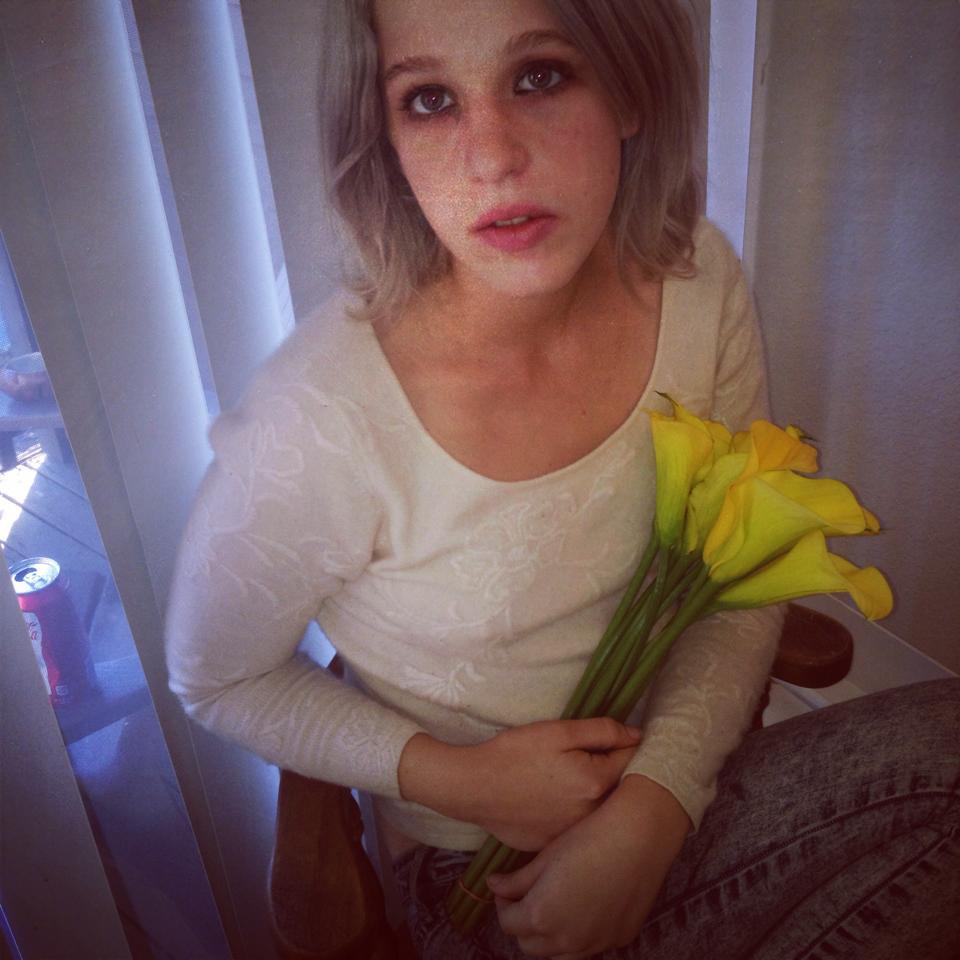

Wong May
Doris Salcedo, A Flor de Piel (detail), 2011, Rose petals and thread, 1333.5 x 650 cm, D.Daskalopoulos Collection Installation view: Doris Salcedo, Museum of Contemporary Art Chicago, February 21–May 2
“To create A Flor de Piel, Doris Salcedo sutured together hundreds of rose petals into a delicate shroud that undulates softly on the floor. Suspended in a state of transformation, the petals linger between life and death and are so vulnerable that they tear if touched. For Salcedo, fragility becomes the essence of the work as she sought to create an “image that is immaterial.” The title is a Spanish idiomatic expression used to describe an overt display of emotions. While that meaning is lost when literally translated, the phrase a flor de piel links flowers and skin, suggesting a sensation so overwhelming that it is expressed physically through a coloring of the body’s surface.
Salcedo’s installations and sculptures often employ minimal forms that subtly evoke the fragility of human life. Viewed in light of the brutal civil war in Salcedo’s native Colombia, this aesthetic sensibility takes on specific political resonances. Salcedo conceived the work A Flor de Piel while she was researching the events surrounding a female nurse who was tortured to death in Colombia and whose dismembered body has never been found. The artist has described the work as a floral offering to this victim of torture, as well as all of those who have been affected by violence. “Suturing the petals is very important because it was a way to bring together all these parts,” Salcedo has said. “Violence destroys everything. Torture destroys bodies. The idea is to bring them together and unite them and recover the force that they had.”¹
Lauren Hinkson
1. Doris Salcedo and Tim Marlow, “Doris Salcedo on A Flor De Pieland Plegaria Muda,” White Cube, May 25, 2012, accessed June 6, 2013.
Letícia Parente, Tarefa I , video, 1982
“Parente, dressed in white, mounts an ironing board, flattening herself against it. Another woman stands beside her, wielding an iron. The woman proceeds to run the iron across Parente, seeming to iron the artist’s blouse and pants while she wears them. While Marca Registrada is the more famous of Parente’s video artworks, Tarefa I is more sophisticated. The viewer can only guess whether or not the experience is painful: whether or not the iron is actually hot remains unknown. Also, the victim/perpetrator dichotomy becomes even more ambiguous despite the material split between the two. While the woman holding the iron is, upon observation, the perpetrator, the victim courts violence by willingly climbing onto the ironing board. Like an automaton, she submits to the iron’s threat. As it moves across her, she remains very still, balancing her body, keeping still so as to avoid being tortured by a burn. This dance between perpetrator and victim, which is at times a dance with oneself, is rendered through exquisite yet plain visual metaphors.”
—Myriam Gurber

The Flagellation of Christ Artist: Paulus Pontius After: Peter Paul Rubens Date: 17th century Location: Not on display Century: 17th Century AD Media: Engraving Dimensions: 37.8 x 28.8 cm (image) Department: Achenbach Foundation Object Type: Print Country: Flanders Continent: Europe Accession Number: 1963.30.10159 Acquisition Date: 1963-04-09

Carolyn
Gage, The Second Coming of Joan of Arc (1987).


Torture of Women’s Major Collage / Painting Cycle November 9 – December 8, 1979


 Little Bristling Soul