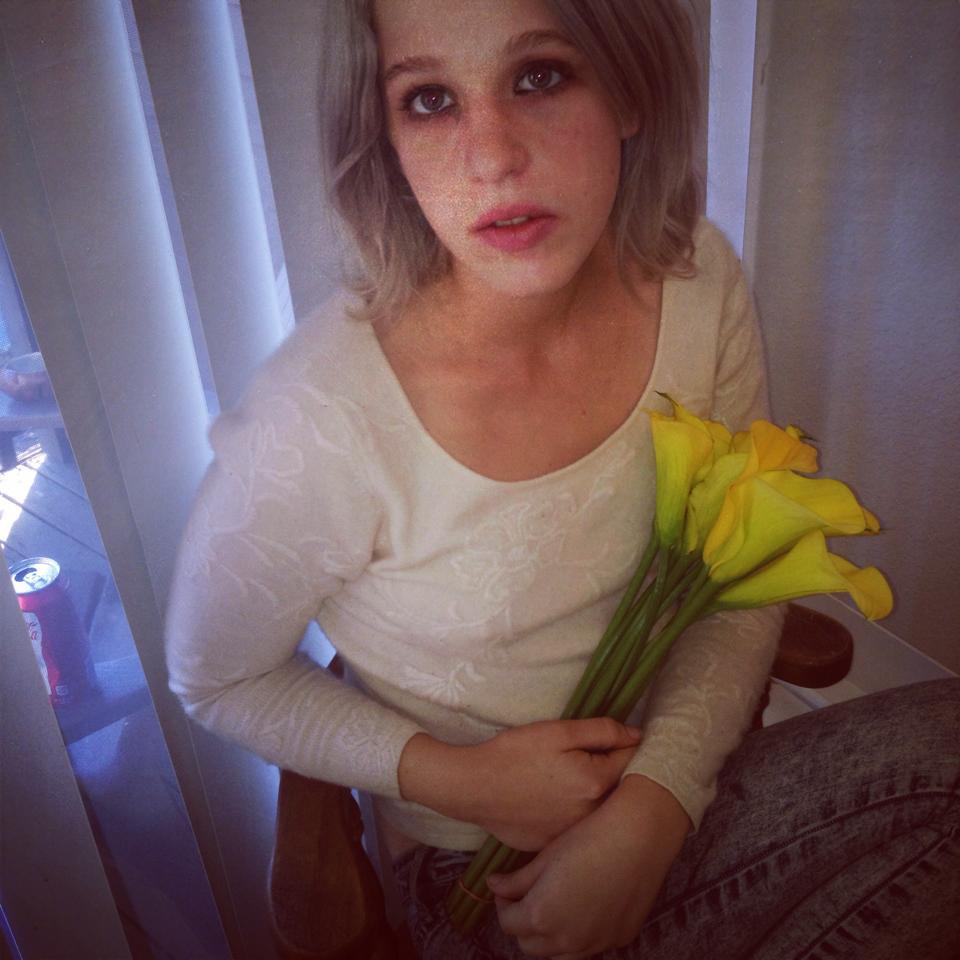
from “The Faces of Joan of Arc” in I Am Not Jackson Pollock: Stories by John Haskell
Tag: power dynamics
DUANE MICHALS
PERSON TO PERSONTom had no idea how long he had been sitting there. It did not matter. She would never call. Yet, deep inside, he still believed in his power over her.
He always had power over her. Tom knew how to make her cry.
Even now, when he thought of her, it was her body that he missed. He wanted to touch her.
By leaving him, her absence gave her a power over him that she had never had when they were together. Tom was filled with an anxiety he could no understand.
He began to think that he saw her everywhere.
His room was filled with a terrible melancholy without her. When he would return, he hoped she would somehow be there. He was always disappointed.
He wondered if she would let a stranger touch her the way he had. He wondered if she had let strangers touch her when they were together.
Leaving a shop one afternoon, he saw her unobserved. Tom was paralyzed and could not move or speak. Later he realized that he was relieved that she had not seen him.
He dreamt one night that she came and kissed him, and with that kiss she entered his body. She looked through his eyes and listened with his ears. In the morning nothing had changed.
Tom found an old night gown of hers in the bottom of his closet. He liked to drape it over his head. It still smelled of her body.
Soon he began to wear a rose in his lapel, because it was her favorite flower. Her favorite things became his favorite things.
He hated himself for sitting there. He hated her for making him want to sit there. Tom began to believe that he could will her call, that his need for her could make her call him.
Suddenly, he knew, at that very moment she was dialing him. It was true. His power had made her call. Now the telephone would ring.
Hello, no Tom isn’t here anymore. I know he’ll be sorry that he missed your call.
I understand how this sounds, but I do not remember always being so aware that love involved another person. The people I’m referring to were, in large part, unconscious instruments for my own development. I still stressed out plenty over the contents of their minds, very quickly forgetting my own. But I was not consistently so interested, maybe, in the real mechanisms of those minds except in so far as they fulfilled or denied my desires, and I understand how that sounds, too.
The total fulfillment of desires is our primary cultural expectation for relationships, which is a problem given that our desires are often vague, confused, ever changing. I didn’t until recently comprehend that a genuine interest in another person’s mind necessitates interest in the parts that may occasionally run counter to your own desires. This feels a fuller way of knowing someone, more exciting, and hard, too, though curiously with much less of the anxiety that romantic narcissism brought. To empathize with a person’s perspective is, among other things, a relief in that it takes you out of your own.
Some time ago my best friend shrugged at me over video chat and this has stuck in my mind with the traction of both revelation and agreement: “Seems interesting to explore what it’s like to grow along with someone else,” she said. The emphasis is mine, I believe.
Almost exactly five years ago I described a burgeoning relationship to Cat as “like when a tornado meets a volcano,” and I thought I was being clever, not just true. She wrote me, recently arrived in China, “Just get here,” and I was grateful to comply. But in those days, making bad decisions provided a brand of certainty: they ensured a failure rate of 100%, a statistic whose fullness at least invited admiration. Being “bad” was a good thing then. Men liked it when you said you weren’t “good at relationships” (as though relationships are a monolith) or “great at monogamy” (when the only real measure is “capable” or “not”). To insist on a low bar was to gain the upper hand, and the idea was you couldn’t be blamed for things later, though that’s never how it worked out. The secret hope was that not showing investment could prevent it; invariably it did not.
I’ve been spending a longer period than advisable at my mom’s house, waiting for my visa to be processed and for tourist season to end in a beautiful city in a messy country across the world. It was inevitable that I would regress, but the part that most alarmed me was the romantic regression: the anxieties that suddenly returned, the uncertainty, the sureness that it was all hanging by a thread and I was powerless to stop it. Powerlessness cultivates awkwardness, excessive sensitivity, self-obsession that erases all the quality aspects of interest in another mind—you start to see in it only what assuages or exacerbates your worry, not its many other dimensions. I could see it happening and yet not prevent it
—“Every Long Letter Is A Love Letter” by Lucy Morris


I would like to see us stop trying to be so damn civil to the people who
are hurting us. I would like for us to stop thinking we need to prove anything to them. They need to prove to us that they can respect our lives enough to make social policy that stops battery. And as long as battery is going on, the woman who is being battered is also being raped. That is the truth from my point of view, and I would like to see us not gloss it over, because every time we do, we tell a lie about what is happening to the woman. And we also make stronger the unspoken assumptions that the sex may be fine, but the battery is something different. The battery is not something different. Possession is the way they’re related.
Andrea Dworkin, Life and Death

“God hath chosen the weak things of the world, to confound the mighty things"
—1 Corinthians 1.27


The Will To Change by Bell Hooks fucked me up good
Actually most of words we use for sex are violent, not just fuck. My Marriage and Family professor pointed this out during my freshmen year of college and it’s stayed with me. Think about it…. bang, screw, hit it, pound, smash, rail, plow, pound, like our entire culture has tried to remove the concept of intimacy and vulnerability and emotion from sex by associating violent words with the action. The power of language on culture, perspective, and overall mindset is so incredible. We gotta be more careful and respectful of that.
 Little Bristling Soul