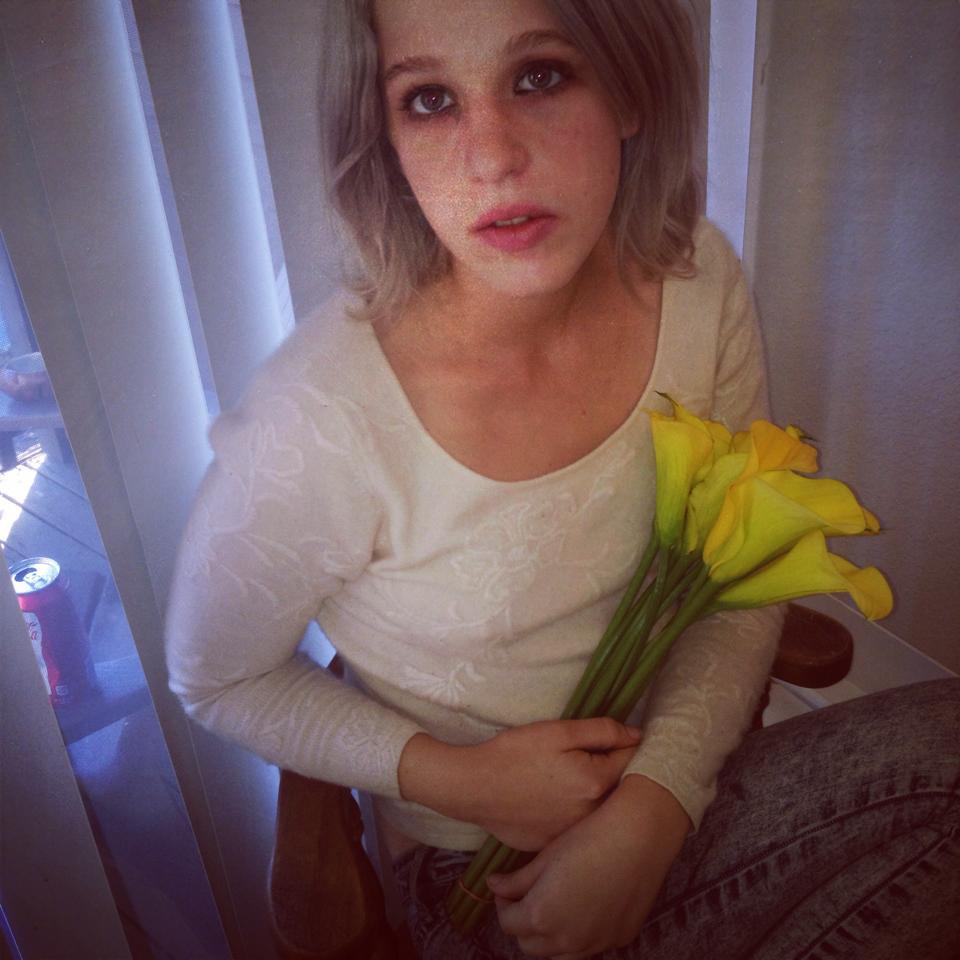
No worries—it stays, even if I go. I enjoy romantic strolls through the wreckage of my early twenties far too much to delete entirely.
Tag: personal
2/3 of my blog is now only viewable to me due to the new tumblr guidelines. I will likely post a heartfelt and sincere goodbye this week, but I advise you to save what you want from here before this blog becomes defunct. Truly (and strangely) shocked and saddened by this turn of events.
Edit: For those who are already asking me if this blog will migrate to a new location—I promise I will give you more details in the near future. This project has always been, to my mind, my own little private haven of hodge-podge hermitude that a fairly significant audience ended up tuning into. That said, it tickles me (aw shucks, honors me) that others have appreciated the art and tidbits that make me enthused about, and intrigued by, an often devastating and senseless world. I will be sure to fill you in on any new home for my obsessions…if such a home is possible. And I welcome suggestions for alternate refuges for misfit digital hoarders.


Pivoting my career to lovelorn siren. Plz endorse me on LinkedIn
hey, could you tag nsfw? im rlly uncomfortable w/ all the genitalia on my dash
I’m sorry—my whole blog is nsfw. It just gets way too difficult, at the rate that I post, to efficiently filter for everything that people have requested I tag as sensitive.
My buddy Mikey Avishay just released his first solo album, a chronicle of breakups with lovers and past selves alike told through deliciously honest bedroom pop. This album is desperate, drunk nights, the longing for safety, for meaning, for love. It’s the music of someone who has been backed into a corner—songs for waking up to grey hungover light and holding on to the glimmer of the future you see through the blinds, the hope that comes when you have no other choice. It is one of those refreshingly earnest albums that was brought into the world simply because the artist seemed to have no other choice than to birth it.
(Also, if you’ve been following my blog for long enough, you’ll know that I am a Virginia Woolf and you can’t go wrong if an album that repeatedly references The Waves).
Mikey writes of “rings”: “I guess what I’m really trying to say is that this album is a breakup album — not just romantically but breaking up with the self, with the past, with the present; fracturing the whole so you can make new presence out of the pieces — but it’s also about putting yourself together again.”
You can buy the digital album or cassette here. Mail orders come with a badge and a tiny chapbook of Michael’s poetry.
http://deathpartyrecords.bigcartel.com/product/avishay-rings-cassette

Violation Removal 🍭🕳
Will you be voting in the midterm elections this November?
Yes! And imma take this opening to urge all eligible voters in the U.S. to do the same. Especially my fellow youngins. For the 2016 presidential election, youth voter turnout was only 48% and in the last midterm elections the voter turnout FOR THE ENTIRE COUNTRY, REGARDLESS OF AGE, was only 36.4% (the lowest turnout since 1942). Among young people the percentage of voters who participated in the most recent midterm election was a pitiful 21.5%. Please please please do not let yourselves be paralyzed my fatalism. Voting is your civic responsibility. You owe your vote, not only to yourself, but to all those who struggled, suffered, and died so that all Americans, regardless of gender, race, class, or creed could participate in our democracy, as well as to the many in our country who remain disenfranchised.
do you have any recommendations for someone who’s just getting into feminist literature? thanks!
Yes! This is hard because it depends on how far back you want to go, and where your primary interests lie….Also, by feminist literature are you looking for theory or for fiction with a feminist bent? If it is the latter you are searching for, I apologize because I already compiled a bunch of theory for you and then realized that might not be what you had in mind.
Edit: I was going to write descriptions and organize this in a more effective way, but I need to move out of my apartment this afternoon and I haven’t slept in two days. Thus, lamentably, I am afraid that I was too ambitious and sprawling and have perhaps merely compiled a useless dump of PDFs instead of offering you succinct and cogent guidance. My apologies.
Anyway; I have bolded and starred the texts that I enjoy most. Most link to full text PDFs.
Early feminist thought:
If you were taking a intro feminist philosophy class they’d probably tell you to start with Mary Wollstonecraft’s A Vindication of the Rights of Women
[1792] which was written as a response to Burke’s Reflections on the French Revolution in which Burke argued that the French Revolution would fail and that society was ultimately bolstered and held intact by traditional structures of property and class. Wollstonecraft echoed Thomas Paine in writing against Burke but augmented his position by further arguing in a humanist bent for the inherent rights of women as equal to that of men. It’s rather dry reading and certainly dated, but is a seminal text that is worth checking out if you want background on more contemporary feminism.
About a half century later you have Sojourner Truth (side note: alongside Joan of Arc, my first heroine as a child) whose A’int I A Woman Speech is underrepresented in feminist philosophy classes but should be included as a canonical text for around this time period as an early rebuke to the white-centric, racist rhetoric of mainstream feminism.
Virginia Woolf—A Room of One’s Own
The Second Wave
The Second Sex by Simone de Beauvoir **
Influenced by existential thought, de Beauvoir writes of the existential unfolding of a woman ’s life; of the ways in which her attitude towards her embodied selfhood alters throughout her lifespan and how this attitude is crafted by society. Sartre observed that whatever we perceive, including other people, is rendered as an ‘object’ to our gaze and is defined by us. de Beauvoir extends this concept to argue that as man “is the Subject, he is the Absolute; she is the Other”. The meaning of what it is to be a woman is given by men.” Thus, women are constantly under siege in a painful conflict between their humanity and their femininity. de Beauvoir writes of the traumatic process, beginning in puberty, by which women lose their selfhood, their agency, “becoming flesh” in the eyes of the society in which they function. In other words, de Beauvoir was perhaps the first to argue that women are not born but made, enmeshed in vast and complex economic, religious, material, cultural, and ideological structures that fabricate and enforce ideas of femininity. While identity theory in the 1970′s led to a massive backlash against de Beauvoir, the immense debt that contemporary feminists owe her is finally being acknowledged once more. I cannot recommend this text enough.
Sexual Politics by Kate Millet
Sexual Politics’s primary focus is an in-depth analysis of the patriarchal bias that underlies literary production. It was the first major work to apply feminist theory to specific works of literature. Authors that Millet critiques include D.H. Lawrence, Henry Miller and Norman Mailer.
The Dialectic of Sex: The Case for Feminist Revolution by Shulamith Firestone ***
“An international bestseller, originally published in 1970, when Shulamith Firestone was just twenty-five years old, The Dialectic of Sex was the first book of the women’s liberation movement to put forth a feminist theory of politics.”
When I first read this book in my freshman year of college, I was completely put off by it. While I had considered myself a strident feminist since age seven, I’d never had any grounding in feminist theory outside of what was easily accessible within the pop-culture saturated, lazy liberal bourgeois mainstream. I was thrown by radical ideas that I’d never encountered and defensive about Firestone’s desire to abolish procreative sex, childhood, monogamy, and natural (physiological vs. mechanized) reproduction.
While I am, perhaps sadly, too cynical and too conventional to jump on board with all of Firestone’s arguments, I’ve grown to love this text in my twenties, both for its willingness to dream wildly and fiercely of how we might construct a more egalitarian society and for its cogent and compelling analysis of feminism as the supplementary radical ideology that unifies Marxist and Freudian concepts and paves the way toward revolution. Ahead of her time to an astonishing degree, she initiated conversations about the ethical necessity to abolish gender that have only truly reached the mainstream consciousness during the last few years.
Overviews of Feminism:
FEMINIST THEORY: from margin
to center by bell hooks
Race and Feminism
bell hooks- Essentialism and Experience
bell hooks–Talking Back: thinking feminist. thinking black.
bell hooks–Ain’t I a Woman?
Gloria Anzaldúa—Borderlands/La Frontera ***
Masculinity and Feminism:
We Real Cool: Black Men and Masculinity by bell hooks
Gender Dynamics and Romantic Partnership:
All About Love by bell hooks ***
The Will to Change by bell hooks (sorry, no pdf on this one)***
Sexuality
This Sex Which Is Not One by Luce Irigaray***
Sexology and Antifeminism, Sheila Jeffreys (PDF)
Toward a Feminist Praxis of Sexuality, Wendy Stock (PDF)
Eroticizing Women’s Subordination, Sheila Jeffreys (PDF)
Nebulously and Generally Categorized Third-Wave Feminism/Poststructuralism
Gender Trouble by Judith Butler***
The Complete Works of Andrea Dworkin***
http://www.mediafire.com/file/kqsshslvh9xd9rr/The+Complete+Works+of+Andrea+Dworkin+%28pdf%29.zip
Rape
Rape Redefined*
Catharine A. MacKinnon
Bodies
Unbearable Weight: Feminism, Western Culture, and the Body by Susan Bordo*** (Sadly, I cannot find this in a PDF)
The Hunger Artists: Starving, Writing, and Imprisonment by Maud Ellmann***

My expression in this photo combined with the Lady Di snapback conveys a couple of crucial things: 1) my only emotion over the past eight months has been frantic shell shock; 2) I’m never letting go of the belief that I can be messy af and still wind up showered with teddy bears and flowers by a teeming throng after my death
hey, i really appreciate your addition to my Chris Burden post. it’s like the first genuine contribution to the discourse around any of my arts related posts. i get so annoyed when people erase my longer captions (usually either contextually or critically relevant to the image in question, especially remarks critical of works i post but don’t like) or they just add a critically-absent ‘this is bullshit’ which i have no time for. anyways, thanks for taking the time to add it. all the best. x
Ah! Of course— thank you so much for the lovely post. I completely understand how you feel about people erasing the larger captions. It happens quite a bit when I am writing something about body art or feminist art and without the context it can just seem like a glorification of an socially un-contextualized, apolitical masochism. Anyway, I love your blog and really appreciate the care you take with your curation, both in terms of the aesthetic flow and because it is obvious that you have an ethics and philosophy behind the work that you catalogue. Each time I look at your page, I challenge myself to slow down on my manic spree posting and move towards a more contextualized curation. Though I am a ways off from that. I’m actually thinking of starting a new blog with a smaller following so I can avoid some of the issues you’ve outlined here. Thank you for what you do—it enriches my life. ❤
The backlash to the #metoo movement is a crash course in the speed with which men will equate the discomfort of being confronted with their own violence with the endemic pain and dehumanization women feel as the recipients of it.
descriptions of dissociation
Depersonalisation
Common: ‘I felt strange / weird’, ‘I felt as if I was floating away’, ‘I felt disembodied / disconnected / detached / far away from myself’, ‘apart from everything’, ‘in a place of my own / alone’, ‘like I was there but not there’, ’I could see and hear everything but couldn’t respond’
Less Common: ‘puppet-like’, ‘robot-like’, ‘acting a part’, ‘I couldn’t feel any pain’ ‘like I was made of cardboard’, ‘I felt like I was just a head stuck on a body’, ‘like a spectator looking at myself on TV’, ‘an out of body experience’, ‘my hands or feet felt smaller / bigger’. ‘when I touched things it didn’t feel like me touching them’
Derealisation
‘My surroundings seemed unreal / far away’, ‘I felt spaced out’, ‘It was like looking at the world through a veil or glass’, ‘I felt cut off or distant from the immediate surroundings’, ‘objects appeared diminished in size / flat / dream-like / cartoon like / artificial / unsolid’
Other dissociative symptoms
Memory: “I drove the car home/got dressed/had dinner but can’t remember
anything about it”, “I don’t know who I am or how I got here” (fugue state), “I
remember things but it doesn’t feel like it was me that was there”.Identity: “I feel like I’m two separate people/someone else”.
Other: “I felt like time was passing incredibly slowly/quickly”, “I get so absorbed
in fantasy/a TV programme that it seems real”, “I felt an emptiness in my head
as if I was not having any thoughts at all”.Source: Jon Ston. Dissociation: What Is It and Why Is It Important? Practical Neurology, 2006; 6: 308-313.
This is seriously something all psychiatric students/professionals/diagnosticians need to read.
There are not enough dissociation-specific “layman’s” words and phrases to highlight what folks with dissociative disorders (or other conditions with marked dissociation) go through.
All we have are these vague sounding terms like the above. So often they’re ignored/belittled, when instead they should be taken seriously and taken as indications to investigate the possibility of dissociation further.
If I had this sort of vocabulary I wouldn’t have spent 8 mystified years referring to how I spent a huge chunk of my waking life as “that feeling that there isn’t a word for” or “the water running out of the bathtub feeling”
 Little Bristling Soul