
Tag: mfa
The poet’s gift is never for the poet’s self, but for another: ‘Hush, hush. All injury / is feeling.’
Allen Grossman, from “Poet’s Sampler: Joanna Klink,” Boston Review (1 April 2000)

Karen Volkman from Spar

Photos:
Gina Pane
1939, Biarritz (Pyrénées-Atlantiques) – 1990, Paris (Paris)
Action Psyché 74
1974
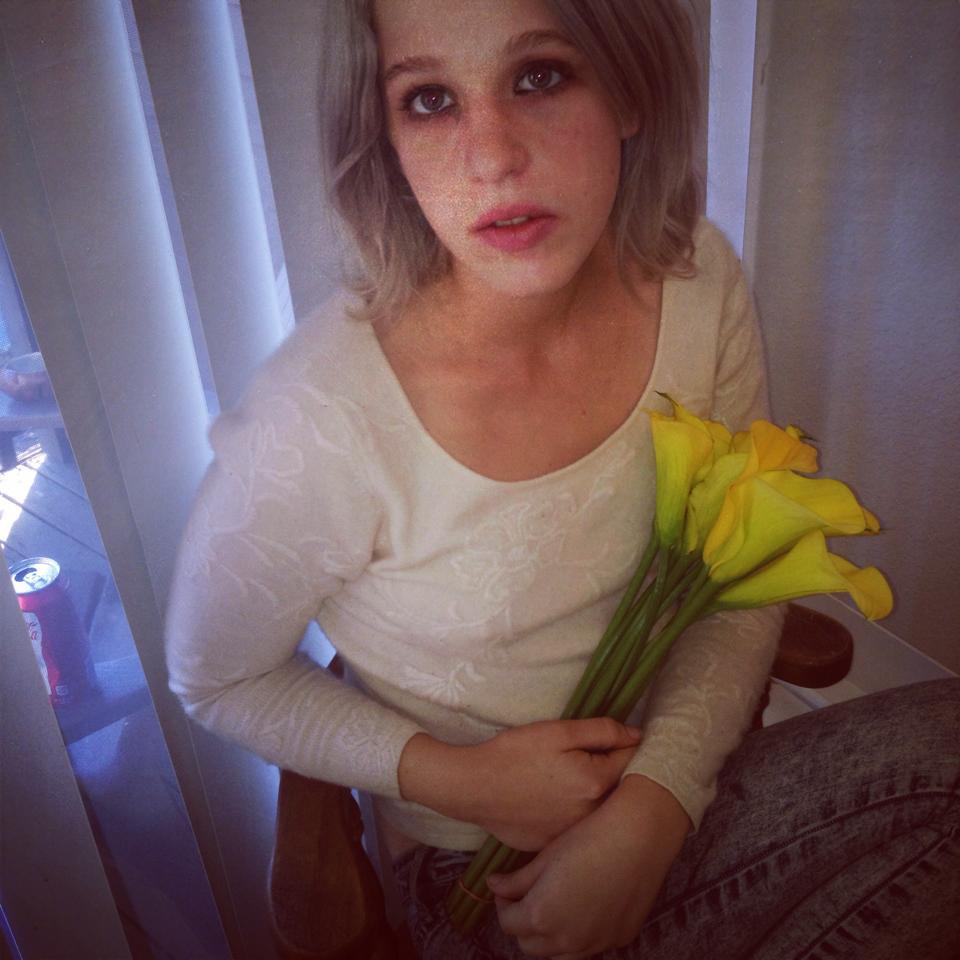
Text: My deeply talented friend, the lovely Anna Blackburn
POEM
My hayseed harlequin
what’s a bloomer to you

and a bobbin to him?
Two grams of Melatonin

won’t put the bitch to bed.
—She’s mazing in bloody pastures.

—She’s got a equinox in the head.
Five six seven eight nine

black angels—ten twelve
fourteen eighteen fare-thee-wells—

won’t scrub the slate to static—
won’t turn the tone to knell—

kneaded and seeded and gadgeted, well,
it’s a why-you-dunnit

and a heck and a hell
and a moon-stung stutter

and a hazy hotel
when a kiss is a vanish

and a flown is a fell.
–Karen Volkman

Joanna Klink, excerpt of “Sorting”, from Raptus
Sets of Things
BY PRAGEETA SHARMA
I’ve been sad and can’t find a seasonal sequence. I go forward then my order reverses and it’s winter again two years ago, with that sticky ice that lost your footing as you gripped that container of Greek yogurt you brought to the doctor’s, even when you couldn’t speak; you only darted your eyes with a fear that continually registered in your pupil size. You clutched your sets of things. I am full of what are sets of things I know well then I go backwards and I don’t have any sets of things. I see your pink-stained washcloth from your wool coat. Your cerebellum tumor is inside with your other tumors but I don’t know it’s there yet neither do you. It appeared and controlled your brain and the things you couldn’t hold. I wonder what things really are, if they are just a set of symbols we sequence and then find purposeful. I wonder if they are like rituals that we learn for our brain. We have those for our body and those for our brain. I look at you — you are alive — and you breathe labored breaths then you died. There, in the hospital bed, when I let time lapse not knowing how to hold you. I let you die for seven days. Your daughter, bigger than I am, could hold you. She could use her muscles to grip you, but I couldn’t hold you, even though you lost forty pounds your last month. I couldn’t find the sequence because I reversed everything into its pain cycle and you didn’t want me to watch you die but I couldn’t understand how everyone could let it happen and I could too, but only if I could let it fall into its hole, its awkward sequence, around death; it’s not awkward it’s just not right. I could make as many intuitive decisions, and many logical sequences occurred around your treatments, but I didn’t know you were stepping out of sequence, and treatments are not producing remedies, and I left myself at the side of the hospital bed. You were in another light, exiting slowly. I thought the sequence of grieving would banish all the anxiety but it came back this year. I became debilitated. I have a debilitating anxiety that I thought was gone. I have too many anxious sequences now and they are blurring meaning. They are blurring my truths like time-lapses and I don’t rush to find the joy of the occurrence without looking for the traps, and my logic, and my stumbling out into another bed that places me in this now-future and you don’t see me because you are no longer alive with me and I can’t rectify this sequence. And I worry that when I love him he will die too. I can’t happen into its learning like it’s wisdom. It’s still deeply unconscious to hold this fear after I banished worry because I looked it in the eyes and it was real and I felt I knew what it looked like. It’s the unknowing learning that I was deeply afraid to imagine and yet it’s your empty bed, your empty closet, you’re empty of the spirited you that gave you to me, in that human way we come to rely upon and that shames us so. And every night of this thinking is a long night of this thinking. Do you fall into bed with us, and I have no idea of this? I’d love to think it’s so, and we have room for your sets of things.

from Grief Sequence, SEQUENCE 7
BY PRAGEETA SHARMA
I thought he was over-medicating himself and planning his suicide. I took the pills away from him. He looked defeated. He said as much. I felt sorry for both of us. His expressions held this enormity and a seared-exhausted center. Spatial discomfort started to affect him but didn’t take hold till the next day, when he started to lose consciousness and rattled the house yelling about thieves, robbers, drunks, and pill-snatchers. We didn’t know what was going on: the tumor was rapidly metastasizing its mass through his cerebellum. His body became harder to manage and he sprung through the house with fear tugging violently at his bile duct tube. Aja and I camped in the front rooms.
The last night of intimacy, of lucidity– unbeknownst to me– we sat together huddled and I caressed him, cradling his arms, his legs, and his penis. I was sure we had time left for more, but this was the last time he spoke and searched my face and looked at me with a recognition I understood.
It’s how we moved out of consciousness. I am haunted by those last days before we succumbed to hospice. I remember how stunning he was resting in bed—that week before, in our library with a cornflower blue-sheeted bed made by Ashby and Spider. In that bed, he had a look of wonder when we put movies on—he excited over Wilson, the ball in Castaway and stared unblinkingly at Tom Hanks. We giggled over this, and appreciated how Andrew put the Eno station on next, and Aja lit and framed this sheeted bed with a twinkling lamp, an illuminant: bulbs he found soothing. We all watched him compose in the air to Philip Glass. I wished that we could have unleashed him to his afterlife then. That’s what he would have wanted: a release to his own universe sonant and material, an ethereal ball. An awkward Tom Hanks, a Wilson, and a castaway in a glittering hand-printed sea. This death sequence was the one I wanted for him.

Richard Hugo
 Little Bristling Soul