

Tag: memory
Alex Dimitrov
whats love and whats fantasy? its hard to trust myself with memories
Alex Dimitrov
Letter to Carl George from Felix Gonzalez-Torres. Postmarked June 21, 1988. (Detail) © The Felix Gonzalez-Torres Foundation
Postcard from Ross Laycock and Felix Gonzalez-Torres. Drawing by Felix. Postmarked April 9, 1987, Canada. © The Felix Gonzalez-Torres Foundation
Felix Gonzalez-Torres, Untitled (1980-1992), C-print, 26.7 x 34.3 cm. (10.5 x 13.5 in, 1991
Letter to Carl George from Felix Gonzalez-Torres, May 12, 1988
Felix Gonzalez-Torres, installation view of solo show at the Andrea Rosen Gallery (curated by Julie Ault and Roni Horn), 2016
Felix Gonzalez-Torres, Untitled (For White Columns), C-print on jigsaw puzzle in plastic bag, 1990
Installation view of Floating a Boulder: Works by Felix Gonzalez-Torres and Jim Hodges at FLAG Arts, 2009-2010
Felix Gonzalez-Torres, Untitled (Love letter), C-print, 22.5 x 33.7 cm. (8.9 x 13.3 in, 1992
Felix Gonzalez-Torres, Untitled (Perfect Lovers), 1991
Felix Gonzalez Torres, “Untitled” (Love Letter From The War Front), 1988. Chromogenic print jigsaw puzzle in plastic bag, 7 3/8 × 9 3/8 × 1/16in. (18.7 × 23.8 × 0.2 cm). Felix Gonzalez-Torres, “Untitled” (Paris Last Time) (1989), C-Print jigsaw puzzle, 7 ½ × 9 ½ in.
Felix Gonzalez-Torres, Untitled" (Wawannaisa), 1991, C Print Jigsaw Puzzle In Plastic Bag, 7 ½ X 9 ½ In.
“In the early nineties, following the death of his lover from AIDS, and railing against the social inequalities and intolerance of the Reagan/Bush era, Felix Gonzalez-Torres wrote: ‘How is one supposed to keep any hope alive, the romantic impetus of wishing for a better place for as many people as possible, the desire for justice, the desire for meaning, and history?’ [1] It is a question that haunts his art, and which remains pressingly relevant as one encounters this major show, installed in all three of The MAC’s gallery spaces.
Famously, Gonzalez-Torres appropriated the aesthetics of minimalism, encoding both personal and radical political content within a restrained formal vocabulary. His ostensibly simple gestures are rich in universal meaning, and abound in metaphors for the diminuition of the body and its passage from life into death…It is an art of light, reflections and shadows, formed of mirrors, festooned strings of light bulbs, curtains of diaphanous gauze or plastic beads; and stacks of posters and so-called ‘spills’ of cellophane-wrapped sweets from which we are each invited to take one home.”
—Ian Massey
“In a way, this letting go of the work, this refusal to make a static form, a monolithic sculpture, in favour of a disappearing, changing, unstable, and fragile form was an attempt on my part to rehearse my fears of having Ross disappear day by day right in front of my eyes…Memory offers a path back to the other side of the line between life and death: it is all that remains after the disappearance of the body.”
—Feliz Gonzalez-Torres
The following text is from an interview between the artist and Ross Bleckner at Bomb:
“RB I think that the art writing, to put it mildly, is slightly out of touch. And I would say that’s generous.
FGT We’re strong enough to be generous. If you’re weak, pussy-footed, you cannot be generous. You have to be very constricted and constipated about everything you own. But if you’re generous it shows you’re strong.
RB Exactly. So are you in love now?
FGT I never stopped loving Ross. Just because he’s dead doesn’t mean I stopped loving him.
RB Well, life moves on, doesn’t it, Felix?
FGT Whatever that means.
RB It means that you get up today and you try to deal with the things that are on your mind.
FGT That’s not life, that’s routine.
RB No, it’s not.
FGT Oh, yes, it is.
RB A lot in life is about routine, and hopefully we can make our routines in life as pleasurable as we know how. Because we connect to our work in a way that’s satisfying and we have some nice relationships. After that, how much more can you ask?
FGT That’s why I make work, because I still have some hope. But I’m also very realistic, and I see that …
RB Your work has a lot to do with hope; it’s work made with eyes open. That to me is very important. Work made with eyes open.
FGT It’s about seeing, not just looking. Seeing what’s there.
RB Do you look to fall in love? Do you need that as a situation? Does it inspire your work?
FGT How can you be feeling if you’re not in love? You need that space, you need that lifting up, you need that traveling in your mind that love brings, transgressing the limits of your body and your imagination. Total transgression.
RB You feel like you had that with Ross?
FGT A few times over.
…
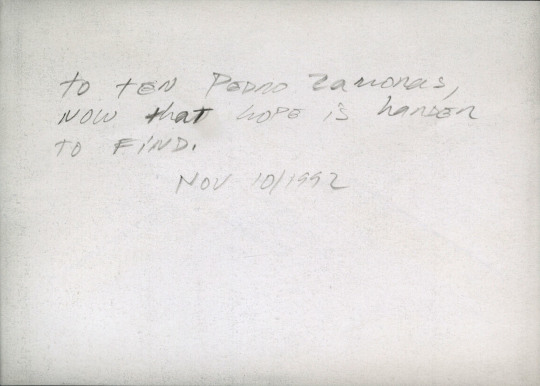
November 12, 1994. Photograph by Felix Gonzalez-Torres. (Reverse) © The Felix Gonzalez-Torres Foundation
…RB Did [Ross] know he had HIV?
FGT No, the year before he got the diagnosis of AIDS he had his appendix removed and they tested the blood and it was HIV positive. But he was a fucking horse. He was 195 pounds, he could build you a house if you asked him to. It’s amazing, I know you’ve seen it the same way I’ve seen it, this beautiful, incredible body, this entity of perfection just physically, thoroughly disappear right in front of your eyes.
RB Do you mean disappear or dissipate?
FGT Just disappear like a dried flower. The wonderful thing about life and love, is that sometimes the way things turn out is so unexpected. I would say that when he was becoming less of a person I was loving him more. Every lesion he got I loved him more. Until the last second. I told him, “I want to be there until your last breath,” and I was there to his last breath. One time he asked me for the pills to commit suicide. I couldn’t give him the pills. I just said, “Honey, you have fought hard enough, you can go now. You can leave. Die.” We were at home. We had a house in Toronto that we called Pee-Wee Herman’s Playhouse Part 2 because it was so full with eclectic, campy, kitsch taste. His idols were not only George Nelson and Joseph D’Urso, but also Liberace.
RB That’s a very nice combination.
FGT Love gives you the space and the place to do other work. Once that space is filled, once that space was covered by Ross, that feeling of home, then I could see, then I could hear. One of the beauties of theory is when you can actually make it into a practice.
…
RB So Felix, I’m curious to what degree the involvement with your work and with gay life, having a lover who’s died—I know that’s effected your work tremendously in the billboards.
FGT It’s also about inclusion, about being inclusive. Because everyone can relate to it. It doesn’t have to be someone who is HIV positive. I do have a problem, Ross, with direct representation, of what’s expected from us.
RB Why?
FGT What I’m trying to say is that we cannot give the powers that be what they want, what they are expecting from us. Some homophobic senator is going to have a very hard time trying to explain to his constituency that my work is homoerotic or pornographic, but if I were to do a performance with HIV blood—that’s what he wants, that’s what the rags expect because they can sensationalize that, and that’s what’s disappointing. Some of the work I make is more effective because it’s more dangerous. We both make work that looks like something else but it’s not that. We’re infiltrating that look. And that’s the problem I have with the sensational, literal pieces. I’m Brechtian about the way I deal with the work. I want some distance. We need our own space to think and digest what we see. And we also have to trust the viewer and trust the power of the object. And the power is in simple things. I like the kind of clarity that that brings to thought. It keeps thought from being opaque.
RB And deluded.
FGT I was visiting in Miami where I saw this beautiful video about someone dying. There was an image of someone swimming underwater and the sound was this very heavy-duty breathing, like someone couldn’t breathe, actually. And that for me would have been more than enough. But then of course they will not trust the strength of that imagery, the combination of imagery and sound. They had to add text to it and flack it up.”

Photograph of Felix Gonzalez-Torres (left), Ross Laycock (center), and Tommie Venable (right) in Paris, 1985.
CHARLES WRIGHT, FROM BYE-AND-BYE
Charles Wright from Bye-and-Bye
Chiharu Shiota, A Room of Memory [21st Century Museum of Contemporary Art, Kanazawa]

Marguerite Duras, Hiroshima, Mon Amour

Louise Gluck

“Untitled” (Vancouver), 1991
Felix Gonzalez-Torres
 Little Bristling Soul