
Sasha Waltz, Dido & Aeneas (2005)
Margaret Atwood from Interlunar
Chase Berggrun | R E D
Agamemnon by Aeschylus | Translated by Sarah Ruden | The Greek Plays
Margaret Atwood, The Penelopiad
Margaret Atwood, The Penelopiad
vs
Ai

Margaret Atwood, The Penelopiad
anne carson
from Nox

psyche
Gina Pane, 1974, 27’32’’
“The word psyche has two meanings; firstly, the human soul, and secondly, from Greek mythology, the name of the ravishingly beautiful daughter of the King of Crete, who is always portrayed with butterfly wings and is worshipped by Eros. A psyché is a cheval glass; a full-length swivelling mirror.
In the tape Psyche (in some texts it is referred to as Psyché), Pane is inspecting herself in a large mirror (a psyché?), and is using make-up to draw an image of her face on that mirror. With a razor blade, she cuts herself just below her eyebrows. Then she goes and stands against a grid, holding a bunch of downy feathers in her hands. With the razor blade, she cuts a cross in the skin around her navel. Between these acts of self-mutilation, she plays with tenni balls, licks her breasts and caresses her body with the feathers. However, these moments never last long. Ritual torture always plays the lead in this ceremony of cleansing. In Psyche, the artist proves herself to be as vulnerable as the mythological King’s daughter with her butterfly wings.”
Text from LIMA

In Action Psyché (Essai), a performance from 1974 Gina Pane injures her eyelashes to simulate tears of blood, and then engraves her belly.
Photos:
Gina Pane
1939, Biarritz (Pyrénées-Atlantiques) – 1990, Paris (Paris)
Action Psyché 74
1974
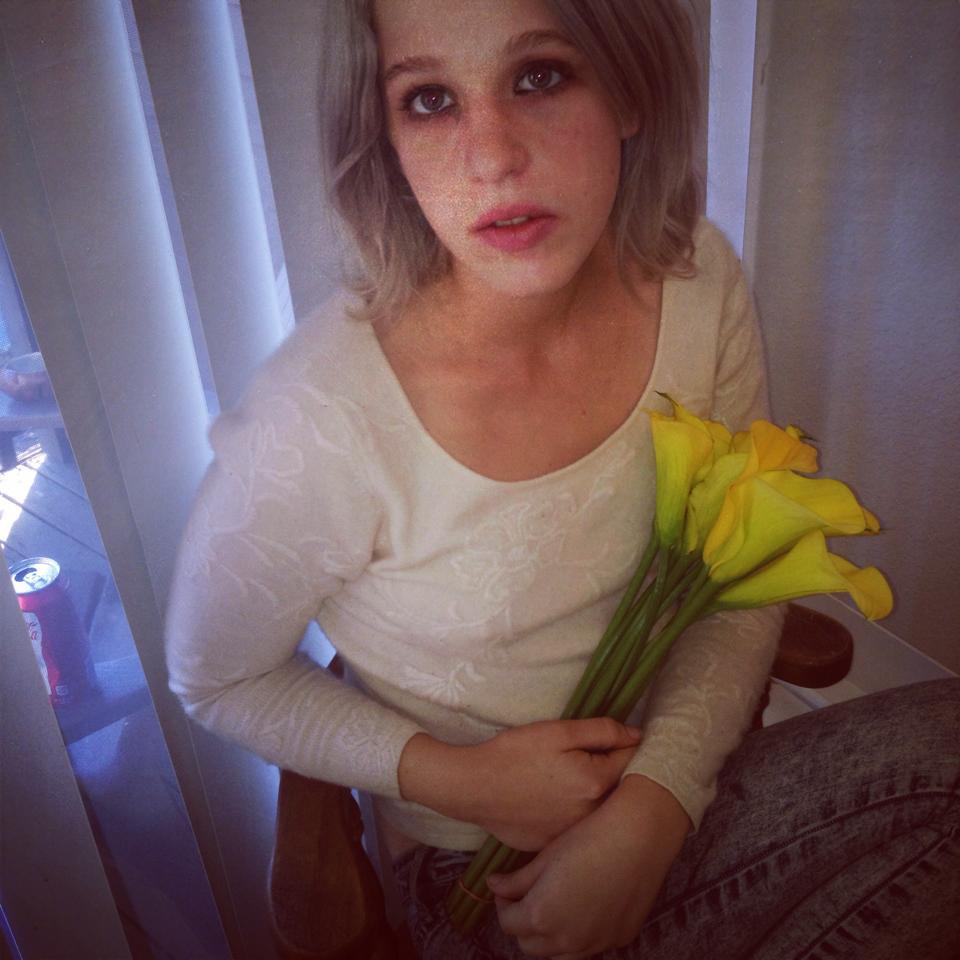
Text: My deeply talented friend, the lovely Anna Blackburn

Gina Pane, Psyché [Psyche], 1974
“The word psyche has two meanings; firstly, the human soul, and secondly, from Greek mythology, the name of the ravishingly beautiful daughter of the King of Crete, who is always portrayed with butterfly wings and is worshipped by Eros. A psyché is a cheval glass; a full-length swivelling mirror.
In the tape Psyche (in some texts it is referred to as Psyché), Pane is inspecting herself in a large mirror (a psyché?), and is using make-up to draw an image of her face on that mirror. With a razor blade, she cuts herself just below her eyebrows. Then she goes and stands against a grid, holding a bunch of downy feathers in her hands. With the razor blade, she cuts a cross in the skin around her navel. Between these acts of self-mutilation, she plays with tenni balls, licks her breasts and caresses her body with the feathers. However, these moments never last long. Ritual torture always plays the lead in this ceremony of cleansing. In Psyche, the artist proves herself to be as vulnerable as the mythological King’s daughter with her butterfly wings.”
—LIMA

Hermann Nitsch, Orgien Mysterien Theater, documentation of performance
 Little Bristling Soul