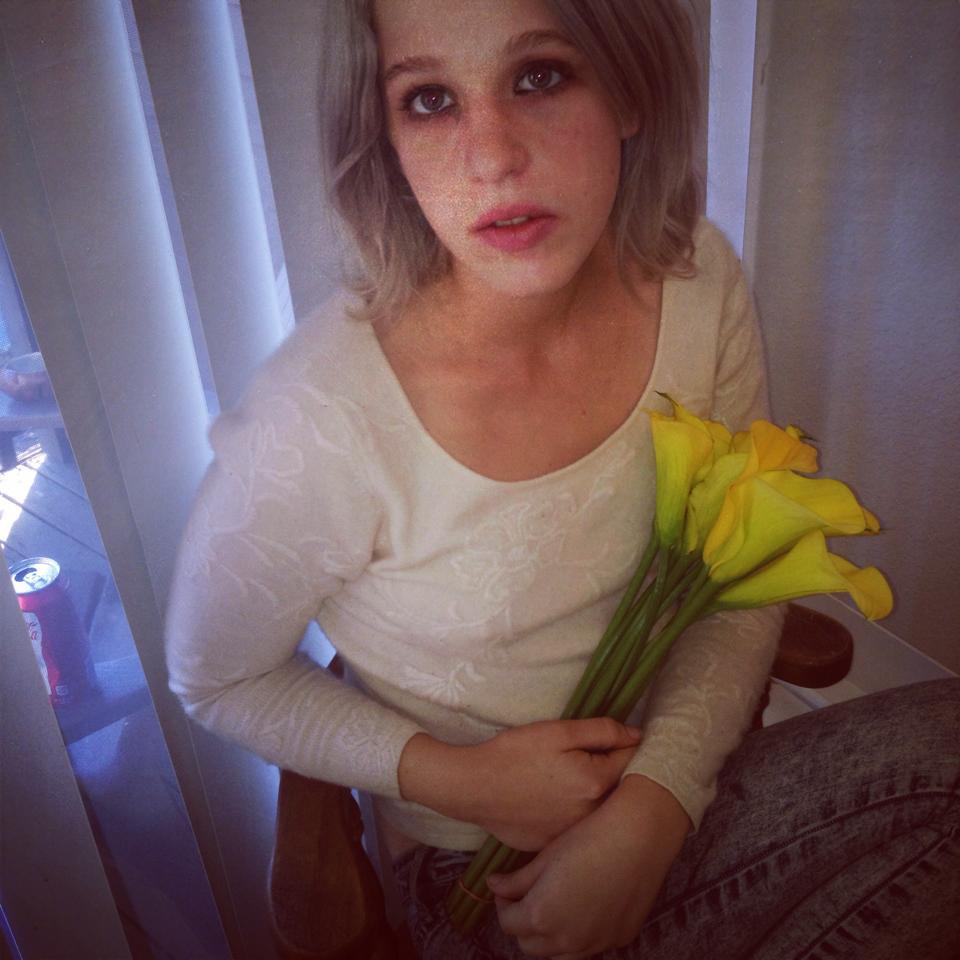
Julien Baker: “Me & My Dog”
Tag: breakup

Tracey Emin, The Last Thing I Said to You was Don’t Leave Me Here II, 2000
This photograph, which was published in an edition of six, is a self-portrait of the artist sitting naked on the floor in the corner of a beach hut. Her back is to the camera and she leans slightly forward. A small tattoo of a scorpion is visible on her left shoulder blade. Thick gold necklaces glint at the nape of her neck. Her pose recalls the vulnerable, dejected figure of a punished child. Paint is peeling from the walls of the empty hut, giving it a ramshackle appearance which heightens the mood of pathos.
Emin bought the beach hut in Whitstable, Kent with her friend, the artist Sarah Lucas (born 1962), in 1992. Emin used the hut as a weekend retreat, going there with her boyfriend. She has talked about the importance of owning property for the first time, saying, ‘I was completely broke and it was really brilliant, having your own property by the sea’ (quoted in Lobel). In 1999, she transported the hut from the beachfront to the gallery, titling it The Last Thing I Said to You is Don’t Leave Me Here (The Hut), 1999 (Saatchi Gallery, London).
The Hut was exhibited for the first time in London in Ant Noises (part two) at the Saatchi Gallery in 2000. (The show’s title was an anagram of Sensation, the 1997 exhibition of work by young British artists in the Saatchi Collection at the Royal Academy, London.) The installation was accompanied by two photographs including the work now owned by Tate. The companion image, The Last Thing I Said to You was Don’t Leave Me Here I, 2000 (National Portrait Gallery, London), shows the artist kneeling on the floor of the hut. She is seen from the side as she leans forward placing her right hand on her knee. Her eyes are closed. Emin has described why she chose to photograph herself naked, saying, ‘The hut is a bare and naked thing. I thought it made perfect sense if I was. It’s also got some kind of weird, religious look in it, like I’m praying or something’ (quoted in Lobel). There is a meditative quality to Emin’s postures in the photographs, and her nudity suggests that she is enacting a private ritual of purification or sacrifice.
In the Tate work the space is particularly confined. The angle of the camera looking down on the figure huddled in the corner puts the viewer in a position of authority. The title suggests that the image documents the aftermath of a lovers’ quarrel, with the woman abandoned in an inhospitable environment. Emin’s work is highly confessional. The Last Thing I Said to You was Don’t Leave Me Here II invites an autobiographical narrative reading but because, unlike in many of her text-based works (see Tracey Emin C.V., 1995, Tate T07632), the story is hinted at rather than spelt out, the viewer is left to draw his or her own conclusions about what may have happened in the hut. The photograph looks like both the staged reconstruction of an incident from the artist’s past and her attempt to derive some peace from a distressing memory. The image invites the viewer to empathise with the artist and to respect the emotional honesty with which she documents and shares her pain.

Title unknown
From Take Care of Yourself, 2007 installation. Curated by Daniel Buren, French Pavilion, 52nd International Art Exhibition, Venice Biennale, Venice, Italy, 2007.
“In 2004, or thereabouts, Calle, France’s best-known conceptual artist, received a break-up letter via email. What followed was an epic and very public act of revenge: a text/photo/video installation called Take Care of Yourself (2004-07), named for letter’s sign-off line. The author is identified only as X. Whether her ex-lover marked it that way or whether Calle did so to protect his identity is unknown. Either way, it’s an apt indicator of the evisceration he receives at the hands of Calle and her collaborators.
For the piece, which debuted in the French Pavilion at the 2007 Venice Biennale, she asked 107 women to respond to the letter. Their collective reaction, laid out in text panels, a cartoon, a bar chart, a loopy diagram that in another context could serve as a guide to sunken treasure, and a great many still photos and videos (including one of a screeching parrot, who, when served the letter, shreds and eats it), forms the centerpiece of Missing…A parrot presented with X’s letter shreds and eats it. Video. At a glance, Take Care of Yourself seems to fit the mold since it contains reams of text. Wade into it and you quickly become engrossed. The pull comes, in large measure, from the letter itself, which you’re encourage to read before entering the exhibit. Larded with false contrition, blame shifting, delusional thinking, weasel words, veiled (and overt) narcissism and a lot of very strained syntax, it lowers expectations for what might be made of it. Calle’s army of analysts upends those expectations. They transform X’s beg-off into a literary event, a firing squad of triangulating voices that together, demonstrate the degree to which words really do matter. What amazes is the sheer variety of approaches taken by those who take X to task. If you walk in, thinking as I did, that you’ll be nonplussed by so much linguistic dissection, be prepared to have your head spun. A criminal psychologist writes: “He is an authentic manipulator, perverse, psychologically dangerous and/or a great writer.” A psychic, after consulting the tarot, concludes: “What is hidden in this letter is worse than what it says. It is the letter of a man who is desperate and threatened….” A judge, citing sections of the penal code, opines: “The letter you received offers a reasonable chance at seeing X condemned by the court both for fraud and for deceit…” Another legal-minded writer frames X’s missive as “the negotiation and performance of a banal lease.” A commentator whose profession I failed to note appraises X’s wish “for things to have turned out differently” as follows: “Yes of course: Blame it on Mom, the Priest, the President, Madonna, his reading of Don Juan, the riots in the suburbs and who knows what else.” About X’s mangled syntax, a Latinist says: “The gentleman has got himself rather tied up in the play of negations.” They are, she determines with palpable exasperation, “absurd and impossible to render.” A police captain chalks up X’s behavior to demographic advantage: Paris has more men than women, so the men do as they please. This multi-pronged deconstruction would be stupefying were it presented solely as text. Calle sidesteps that pitfall. She frames each text differently and pairs it with an environmental portrait of the author, interspersing forensic touches, like diagrams that chart repeated phrases and the number of words in each sentence of X’s email missive.”—David M. Roth
Sophie Calle from Exquisite Pain
Desire doesn’t aspire
to anything other than itself—I don’t miss so-&-so,
just being seen in that way,just having an unholy place
to rest, set all this down— Alina Pleskova, from “Re:Eros,” published in the American Poetry Review

Kathy Acker, Blood and Guts in High School

Sophie Calle, Exquisite Pain, 15 days ago, 1984, Perrotin
Kathy Acker

From Kathy Acker’s Blood and Guts in High School
Kathy Acker from Blood and Guts in High School

June Jordan

 Little Bristling Soul